|
|

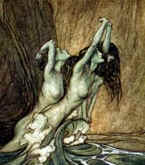
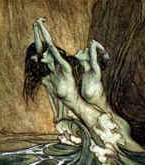
Deriving from the Gaelic word murúch the Merrow is the Irish
equivalent of the mermaid and mermen of other traditions. These beings are said to
appear as human from the waist up but have the body of a fish from the waist down.
They have a gentle, modest, affectionate and benevolent disposition.
There
are other names pertaining to them in Gaelic - Muir-gheilt,
Samhghubha, Muidhuachán,
and Suire. They would seem to have been around for millenia because according
to the bardic chroniclers, when the Milesians first landed on Irish shores the Suire, or
sea-nymphs, played around them on their passage.
The merrow were capable of attachment to human beings and there are reports of
them inter-marrying and living among humans for many years. However usually they
eventually return to their former homes beneath the sea.
Merrow-maidens are reputed to lure young men to follow them beneath the waves where
afterwards they live in an enchanted state. Merrows wear a special hat called a cohuleen
druith which enables them to dive beneath the waves, if they lose this cap it is said
they have no power to return beneath the water. Sometimes they are said to leave
their outer skins behind, to assume others more magical and beautiful. The merrow
has soft white webs between her fingers, she is often seen with a comb parting her
long green hair on either side. Merrow music is often heard coming from
beneath the waves.
An old tract found in the Book of Lecain states that a king of the
Fomorians,
when sailing over the Ictean sea, had been enchanted by the music of mermaids until he
came within reach of these sirens .... then they tore his limbs asunder and scattered them
on the sea.
From Dr. O'Donovan's Annals of the Four Masters - Entered in the year 887 ad.
there is a curious tale of a mermaid cast on the Scottish coast - Alba - She was
195 feet in length and had hair 18 feet long, her fingers were 7 feet long as was her
nose, while she was as white as a swan.
Most of the stories are about female beings however there are some about mer-men who
capture sailors and keep them in cages under the sea.
Source: O'Hanlon, John - Irish folklore: Traditions and
Superstitions of the Country. first published 1870. republished by EP Publishing
Ltd., 1973.
picture source:
Arthur Rackham
Stories, Myths
and Legends associated with the Merrow
Flory
Cantillon's Funeral
The Wonderful Tune
The Lady of
Gollerus
top

© Shee-Eire:
|